


Eco Mural 9: Eastern Tiger Swallowtail Butterfly
Location: Cedar Park Triangle, Catherine St. & Baltimore St., West Philadelphia, PA | Date: 2019
Artist: Designed, illustrated, and painted by Hagopian Arts

Supporting Flower Species
The species displayed here is an Eastern Tiger Swallowtail: one of the many stunning butterfly species of North America. These butterflies frequent gardens across the United States, often found sipping on the nectar of common native flowers. Like all butterflies, Eastern Tiger Swallowtails are pollinators who depend upon a wide and healthy population of flowers to feed upon. Swallowtails support thousands of flower species by collecting pollen on their legs as they drink nectar from deep within the flower. The pollen is distributed to other flowers as the butterfly travels, providing fertilization and ensuring genetic diversity. Pollinators are particularly sensitive to environmental degradation: specifically human encroachment on their natural habitats, use of pesticides and preservatives, climate change, and pollution. For more information about pollinators and links to relevant environmental advocacy organizations, please visit our Honey Bees and Pollinators page.


Hagopian Arts is pleased to unveil a new form of Eco Mural: a printed asphalt installation! Through a partnership with Cedar Park Neighbors and University City District, a large-scale version of our butterfly panel from the Eco Mural Project 2: Symbiosis mural was placed in the pedestrian triangle at Cedar Park in West Philadelphia. We are so pleased to have an Eco Mural at ground level for children and residents to interact with and enjoy. During the first Baltimore Street Dollar Stroll of summer 2019, we passed out flyers and stickers for our neighbors to celebrate the butterfly’s installation and connect with our community. Hagopian Arts was honored to be chosen by University City District to bring this unique form of mural reproduction to our neighborhood, and we look forward to future endeavors with Cedar Park Neighbors and UCD to bring more Eco Murals to West Philadelphia and beyond!

About the Eco Mural and Wild Medicine Projects
The Eco Mural Project by Hagopian Arts is an ongoing series of public art installations designed to educate and inspire action on ecological and cultural issues. Each mural is a meticulously detailed, one-of-a-kind piece, blending vibrant artistry with rigorous research. These murals transport viewers into immersive natural environments, revitalizing urban spaces while addressing pressing concerns about environmental degradation.
Within this initiative, the Wild Medicine Eco Mural Project focuses specifically on the cultural heritage of medicinal plants. Through detailed depictions and thoughtful programming, the series highlights the historical, cultural, and healing significance of plants, fostering a deeper connection between individuals and the natural world.
The Eco Mural Project is rooted in the belief that reconnecting communities with nature can profoundly impact mental and physical health. These murals showcase the beauty of local flora and fauna, enlivening public spaces and encouraging residents to see their environment in a new light. This engagement inspires a sense of pride, belonging, and collective responsibility for the natural world. To enhance accessibility, each mural includes a scannable QR code linking viewers to a webpage that provides detailed information about the artwork, the plants featured, and their historical and cultural significance. These pages also honor Indigenous histories by sharing the uses, markers, and cultural associations of the depicted flora and fauna.
Community-Driven Programming and Collaborations
Hagopian Arts amplifies the impact of its murals through live events, educational initiatives, and community partnerships that engage people across generations and cultures.
Hagopian Arts transforms urban landscapes through art that bridges the worlds of ecology, education, and cultural heritage. Each mural is a portal into the hidden wonders of the natural world. By blending intricate artistry with educational outreach, Hagopian Arts inspires communities to rediscover the beauty and importance of the environment they call home.
Honoring Indigenous Histories and Local Ecosystems
A standout project in the Wild Medicine Series is Eco Mural 21 at Bartram’s Garden, a series of freestanding mini murals showcasing medicinal plants historically used by the Lenni Lenape people. Designed with community input, the murals feature local flora, Lenape beadwork patterns, and depictions of children on the riverbank where passionflowers grow.
Hagopian Arts conducted extensive research into Bartram’s Garden’s historical catalog to honor the Lenape people’s contributions and highlight the cultural significance of the plants. At the unveiling event on September 15th, Melaney Gilchrist, a West Philadelphia herbalist, and mindfulness yoga practitioner Nakesha Moore of Breathe Moore led workshops for community families. These sessions explored the medicinal properties of the plants while fostering connections between art, history, and wellness practices.
Through its murals and programming, Hagopian Arts creates vibrant spaces for education, inspiration, and dialogue. The Eco Mural Project bridges art and environmental advocacy, encouraging communities to cherish their local ecosystems and honor the cultural and historical ties that bind them to the natural world.
Wild Medicine: A Multidimensional Creative Experience
This live event combined public art, botanical installations, body-painted models, and performance art to merge the worlds of creativity and herbal wisdom. Hosted in collaboration with women artists, herbalists, and grassroots organizers, the event invited participants to explore the healing connections between art and nature.
Ancient Ancestral Connections
Eco Mural 18: Women’s Wild Medicine celebrates the ancestral bond between women and medicinal plants, featuring women from diverse cultural backgrounds alongside flora from their heritage. Installed at Penn OB/GYN, the mural also serves as a pilot for the Women’s Wild Medicine Initiative, a community-driven effort that highlights the healing power of native plants and their historical ties to women.
Wild Medicine Coloring Journal and Foraging Guide
In collaboration with educator and illustrator Katie Lillard, Hagopian Arts produced the Wild Medicine Journal and Coloring Illustration Booklet, inspired by the two murals created for Wild Medicine Eco Mural 15: Mugwort, Mullein, and Mallow. The booklet features twenty medicinal plants rendered in Hagopian Arts’ signature style, blending pattern, naturalism, and realism.
Hagopian Arts distributed the journal and accompanying foraging guides to schools and community organizations to introduce youth aged 3-18 to ecological awareness in both traditional and nontraditional learning settings. These resources were also shared during a mural unveiling, empowering community members to safely connect with wild plants and explore their uses in daily life.
Highlighting Interconnectivity: Eco Mural 20
As part of the Wild Medicine Eco Mural Project, Hagopian Arts created Eco Mural 20: Artelo to celebrate the interdependent relationships between plants, pollinators, and human communities. This mural was a collaborative effort with Square Roots Collective and 14 other public artists contributing uniquely to the Artelo hotel project. While each artist brought a distinct vision to the hotel’s art-filled rooms, Hagopian Arts focused on the ecological and cultural themes central to the Wild Medicine Eco Mural Project.
To expand its reach, Hagopian Arts hosted interactive workshops that engaged community members in the creative process: At Hyacinth Montessori School in West Philadelphia, children aged 6–12 participated in a painting workshop, learning about local flora and pollinators while contributing sections to the mural. This activity incorporated yoga and mindfulness practices led by Breathe Moore, blending creativity and well-being.
At John Heinz National Wildlife Refuge, community members painted portions of the mural while learning about the featured species and their roles in local ecosystems.
In September 2024, Hagopian Arts partnered with the Kennett Trails Alliance and Artelo for a public mural painting event during the Hispanic Heritage Festival in Kennett Square. Using a paint-by-number system and hand-mixed colors, participants painted sections inspired by the flora, fauna, and geometric patterns of Eco Mural 20. The mural, once finalized by Hagopian Arts, will be installed in Kennett Square in 2025, further expanding its impact and reach.

HAGOPIAN ARTS' FINE ART MURAL REPRODUCTIONS
Limited edition, museum quality prints of hand-painted murals using archival-grade inks and premium textured vinyl
At Hagopian Arts, we bring the beauty and depth of meticulously hand-painted murals into your space through our fine art-quality vinyl mural reproductions. These murals capture the richness of highly rendered realism, seamlessly woven with ornamental patterning, reflecting our signature artistic style. Our Botanical and Eco Murals celebrate the natural world, offering a striking yet timeless fusion of art and design.
A percentage of sales is donated to an environmentally driven non profit working to mitigate the decline of pollinators.


Related Projects
.jpg)
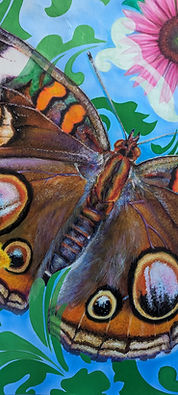
Eco Mural 17: Cecropia, Luna, Buckeye
Amidst the rich patchwork of Pennsylvania’s flora and fauna, few inspire more wonder or enchantment than our native butterflies and moths. With their vibrant colors and patterning, delicate forms, and graceful flight, these winged mosaics have captivated our collective imagination for centuries. Moths and butterflies are both members of the order Lepidoptera, a name derived from the Greek terms “lepis,” meaning scale, and “pteron,” meaning wing. In fact, all moths and butterflies are entirely covered in tiny scales! Another defining feature of Lepidopteran species is complete metamorphosis, meaning they undergo distinct life stages, each completely different from one another. Butterflies and moths have a symbiotic relationship with the native flora, meaning a close, long-term interaction, in which each organism is mutually benefited.

Wild Medicine Eco Mural 15: Mugwort, Mullein, and Mallow
Nestled between tree roots, sprouting along riverbanks, and dotting wide open fields, a careful eye will find precious gifts of nature—wild medicine. Philadelphia is gifted with a great variety of edible and medicinal plants and fungi. Our neighborhoods provide a landscape for foraging natural treasures like fruit trees, nuts and berries, and wild plants—often mistaken for “useless weeds.” For centuries, local flora has provided medical benefits and sustenance that soothe maladies from ear infections to high blood pressure, and boost wellness by aiding sleep, relaxing muscles, and more.

Eco Mural 14: Barn Swallows
These beautiful birds have been friends of people in America for centuries, and signal the coming of spring as they make their annual migration back from South America. Swallows are incredible long-distance migrants, flying up to two hundred miles per day in order to reach appropriate temperatures throughout the year. A common Indigenous American folklore tells of a daring swallow who stole fire from the gods in order to give it to humans. In retaliation, an angry deity threw a firebrand at the bird, singeing off the center of his tail, resulting in the unique fork. Science has taught us that Barn Swallows actually use their tails to chase down insects and perform impressive aerial stunts.

Eco Mural 13: Luna Moth
Few moths are as beautiful or as striking as the Luna Moth. Its vibrant green wings, magenta markings, and graceful elongated hindwing tails make them the subject of much admiration amongst entomologists and nature-lovers alike.
The Luna Moth is the largest moth in North America, averaging a wingspan of about 3-4 inches. Luna Moths prefer to live in deciduous forests and have an expansive range that covers the eastern half of North America.

Eco Mural 11: John Heinz National Wildlife Refuge at Tinicum
Located in West Philadelphia, John Heinz serves both as a state funded zone of protection for some of Pennsylvania’s most vulnerable wildlife, and as an educational hub for students and residents across Philadelphia County. John Heinz Wildlife Refuge at Tinicum was founded in 1972 after lobbying by concerned citizens as the last local marsh was threatened by industrial expansion. When settlers arrived in Pennsylvania in the 1600s, a process of draining and filling the marshland to create grazing land for livestock reduced the size of marsh from approximately 5200 acres to just under 350 by the 20th century.

Eco Mural 2: Symbiosis
Symbiosis is a term used to describe long-term relationships between two or more different organisms within an ecosystem. There are three categories of symbiotic relationships: mutualistic (both organisms benefit), commensalistic (one organism benefits, the other is unaffected), or parasitic (one organism that benefits at a detriment to the other organism). Like humans, organisms across every imaginable habitat cooperate to survive, reproduce and thrive. Sometimes these relationships are so specific that they evolved together: without the varied species of bacteria we have in our gut, we could not absorb vitamins or digest dairy. Without us, those bacteria would likely not exist at all in their current evolutionary form.
Partnership Links:
Learn More & Get Involved:
Department of Conservation and Natural Resources - Landscaping with Native Plants
The Lepidopterists' Society