


Wild Medicine Eco Mural 24: MKE | Living Systems
(In collaboration with the Kennett Trails Alliance and Square Roots Collective)
Location: Art Intersection MKE, Milwaukee, WI | Date: 2025
Artist: Designed, illustrated, and painted by Hagopian Arts

A Study of Living Systems, Ecology, and Interdependence
Wild Medicine Eco Mural 24: MKE | Living Systems is a site-responsive public artwork created for Art Intersection MKE, an outdoor community space where public art, ecological systems, and green infrastructure are intentionally integrated on formerly vacant land.
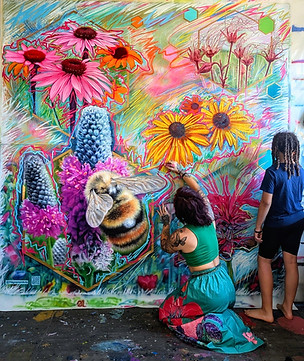
The composition is built directly from native plants growing on-site, including purple prairie clover, coneflower, bee balm, black-eyed Susan, and prairie spiderwort. A rusty patched bumblebee anchors the work, emphasizing the relationship between plant and pollinator and the idea that health exists through interdependence across land, bodies, and community systems.
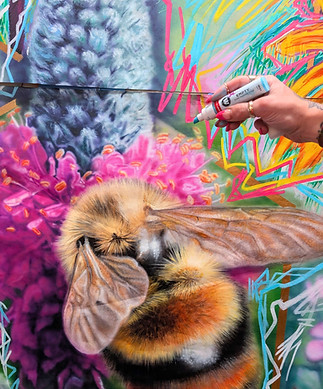
Visually, the mural is developed through a combination of hand painting and airbrushing acrylic paint, layered with energetic mark making. Realism anchors the work, while line, pattern, and structure connect each element across the composition.
Hexagonal frameworks and hand-drawn marks create a visual language that ties the plant systems together, allowing the piece to function as a network rather than a collection of separate parts.
The mural was developed entirely in my West Philadelphia studio and is designed to transition into a living ecological site, carrying that same level of detail and care into shared public space.


Site Context: Art Intersection MKE
Art Intersection MKE is a community-centered ecological and cultural site built on formerly vacant land in Milwaukee. The space integrates native plant systems, pollinator habitat, green infrastructure, and public art into a cohesive environment designed for long-term sustainability and public access.
The site includes a growing series of free-standing 8’ x 8’ murals created by artists both local to Milwaukee and from across the country. Together, these works form an evolving outdoor gallery, placing individual murals within a broader network of artistic voices and perspectives.
Native prairie plantings at the site are selected for ecological function. They rebuild soil health, support pollinators, manage stormwater, and return seasonally with minimal intervention.
Located within a historically disinvested urban landscape, the project reflects a commitment to long-term investment, where ecological function, durability, and access to well-designed public space are treated as essential.
This mural responds directly to that framework, drawing from the living systems already present on-site while existing as part of a larger public-facing installation that brings together art, ecology, and community use.

Flora, Pollinators, and Medicinal Context
The mural centers five native prairie plants growing at Art Intersection MKE:
-
Purple Prairie Clover (Dalea purpurea)
-
Purple Coneflower (Echinacea purpurea)
-
Wild Bergamot / Bee Balm (Monarda fistulosa)
-
Black-Eyed Susan (Rudbeckia hirta)
-
Prairie Spiderwort (Tradescantia occidentalis)
These plants are foundational to prairie ecosystems. They support pollinators throughout the growing season, contribute to soil regeneration, and help sustain balanced plant communities over time.
Within the Wild Medicine series, these species are understood as carriers of cultural and historical knowledge. Across Indigenous and land-based traditions, as well as regional herbal practices, these plants have supported healing through observation, seasonal use, and relationship to place. That knowledge continues to evolve.
Today, these plants remain present within contemporary culture through herbal practices, community gardens, ecological restoration, and conversations around environmental health, access to green space, and reconnecting with land-based knowledge. Purple prairie clover restores soil through nitrogen fixation while also appearing in traditions connected to respiratory health and vitality.
Coneflower is widely associated with immune support and resilience across both ecological systems and cultural use. Bee balm has been used in teas and inhalations while serving as a critical nectar source for pollinators. Black-eyed Susan is known for its adaptability and presence across open landscapes, with uses connected to general wellness practices. Prairie spiderwort supports early-season pollinators and reflects cycles of seasonal transition.
In the mural, these plants are not isolated. They exist as part of a shared system shaped by ecology, culture, and place. A rusty patched bumblebee (Bombus affinis) serves as the central pollinator. Once common throughout the Midwest, this species is now federally listed as endangered due to habitat loss, pesticide exposure, disease, and climate pressure.
Bumblebees are essential pollinators for both native and agricultural systems. Their decline reflects broader environmental stress. Health emerges through diversity, balance, and sustained care.
Artistic Approach and Materials
I developed this mural through a layered fine art process that moves between realism, pattern, and expressive mark-making. Highly rendered forms anchor the composition, while pattern and line create movement across the surface. Hexagonal structures reference self-organizing systems found in nature.
This project marked a shift in my practice through the development of a marker-based system designed to work in direct relationship with acrylic brushwork and airbrush. I used this system to tie the four primary hexagonal plant structures together, using these marks as a visual language. I had to make them talk to each other. Rather than functioning as an overlay, the marker work interacts directly with the painted surface, connecting forms and creating continuity.
The process became a study of color, light, and energy that connects everything within an ecosystem.
These images reflect the studio phase of the work, where the mural was developed in sections on mural cloth. Working off-site allows for a high level of detail, layering, and control while preparing the work to transition into a public outdoor environment. The mark making, airbrush, and hand-painted layers were built in relationship to one another, allowing the composition to develop as a connected system rather than in isolated parts.
The mural was created using brushwork, airbrush, and paint marker systems.
Materials support for this work was provided by
MOLOTOW (@molotowheadquarters)
Golden Artist Colors (@goldenpaints)
Community Activation
At Art Intersection MKE, the mural exists within a larger public-facing system that integrates ecological infrastructure, public art, and shared outdoor space.
The site is designed for ongoing use, creating opportunities for engagement, learning, and connection through direct interaction with the work and surrounding landscape.
Each Eco Mural includes a scannable QR code installed on-site, allowing viewers to access deeper layers of the work, including plant and pollinator information, site context, project partners, and process documentation.
This creates a self-guided educational experience embedded within the space.
Public art functions here as part of a living system, where art, ecology, and education operate in direct relationship.
Living Systems
This mural exists within a network of relationships between plants and pollinators, land and people, and the systems that support them.
Installed within a site designed for long-term ecological function and community use, the work becomes part of a larger system of care.
Health is not isolated. It is built through relationships.





The Eco Mural Project + Wild Medicine Series
The Eco Mural Project is an ongoing body of site-responsive public artworks that explores ecology, cultural history, and community through fine art painting.
Within that, the Wild Medicine series focuses on plants and pollinators and their connection to the cultural and ecological context of each location. Each mural reflects a specific landscape while connecting to broader systems of environmental and community interdependence.
Across the series, medicinal plants are understood through relationships to pollinators, to cultural knowledge, and to the communities connected to each place.
Each mural extends beyond the painted surface through QR-linked content, offering deeper access to ecological information, project context, and process documentation.
Related Projects

Wild Medicine Eco Mural 23: Kennett Greenway
Wild Medicine Eco Mural 23: Kennett Greenway transforms the Kennett Greenway into a living outdoor gallery where art, ecology, and community converge. Created in partnership with the Kennett Trails Alliance and Square Roots Collective (SRC), the project weaves together fine art, environmental education, and cultural storytelling through four free-standing murals, a companion Wild Medicine Plant Identification Guide & Coloring Journal, immersive community workshops, and the culminating Wild Medicine Unveiled event.
.jpg)
Wild Medicine Eco Mural 21: Bartram’s Garden
As part of the multi-year transformation of the 56th Street Corridor, Wild Medicine Eco Mural 21: Bartram’s Garden celebrates the essential roles of local pollinators and medicinal plants, many of which were traditionally used by the Lenni Lenape people. This Eco Mural Project consists of eight free-standing mini murals located at the 56th Street Gateway, where Lindbergh Boulevard meets 56th Street near the lower entrance to Bartram’s Garden. Each mural is meticulously hand-painted and mounted on custom-fabricated structures that complement the artwork’s unique shapes and borders, offering a dynamic visual experience.
.jpg)
Wild Medicine Eco Mural 20: Artelo
Our delicate ecosystems rely on the intricate relationships between plants, pollinators, and human communities. Wild Medicine Eco Mural 20: Artelo celebrates this mutual interconnectedness through a vibrant depiction of local flora, fauna, and their vital roles within the environment. Created by Hagopian Arts in collaboration with Square Roots Collective (SRC), this mural embodies the synergy between nature, culture, and community.

Wild Medicine Eco Mural 18: Women's Wild Medicine
The Wild Medicine mural portrait installation at Penn OB/GYN is a pilot piece for The Women’s Wild Medicine Initiative. This project has been in the making for years, as it draws from work dating back to 2016, exploring women’s empowerment captured in naturalistically embodied portrait paintings. This mural project serves to highlight the ancient ancestral connection between women and the wild medicines of their cultural roots.

Wild Medicine Eco Mural 17: Cecropia, Luna, Buckeye
Amidst the rich patchwork of Pennsylvania’s flora and fauna, few inspire more wonder or enchantment than our native butterflies and moths. With their vibrant colors and patterning, delicate forms, and graceful flight, these winged mosaics have captivated our collective imagination for centuries. Moths and butterflies are both members of the order Lepidoptera, a name derived from the Greek terms “lepis,” meaning scale, and “pteron,” meaning wing. In fact, all moths and butterflies are entirely covered in tiny scales! Another defining feature of Lepidopteran species is complete metamorphosis, meaning they undergo distinct life stages, each completely different from one another. Butterflies and moths have a symbiotic relationship with the native flora, meaning a close, long-term interaction, in which each organism is mutually benefited.

Wild Medicine Eco Mural 15: Mugwort, Mullein, and Mallow
Nestled between tree roots, sprouting along riverbanks, and dotting wide open fields, a careful eye will find precious gifts of nature—wild medicine. Philadelphia is gifted with a great variety of edible and medicinal plants and fungi. Our neighborhoods provide a landscape for foraging natural treasures like fruit trees, nuts and berries, and wild plants—often mistaken for “useless weeds.” For centuries, local flora has provided medical benefits and sustenance that soothe maladies from ear infections to high blood pressure, and boost wellness by aiding sleep, relaxing muscles, and more.
Project Partner: